Showing posts with label Genealogy education. Show all posts

Thursday, February 23, 2017

The Secret Hiding on the 1840 U.S. Census

[Note: My Kith N Kin is moving! Though this site will remain open, new genealogy techniques, articles, and more will now be posted to The Genealogy Reporter. Come on over and subscribe!]


As an avid genealogist, you likely know the first U.S. census to include the names of all the persons in a household was 1850. Before that, the federal census only named the head-of-household, and the other members of the family were simply a tic mark in the appropriate age and gender columns.

Hidden Secret in the 1840 U.S. Census

But, there is a secret hiding on the 1840 U.S. census. On the back of this census, the enumerators recorded those who were receiving Revolutionary War and other service pensions by name and age. The lists also named the head-of-household in which the individual was residing.

These lists were published in A Census of Pensioners for Revolutionary or Military Services; with their Names, Ages, and Places of Residence, as Returned by the Marshals of the Several Judicial Districts, under the Act for Taking the Sixth Census and you can review this publication for free at several online book repositories, like Internet Archive. The book is organized by state, then county.

Better yet, you can search the list quickly by name at the Findmypast database titled "1840 United States Census, Revolutionary War Veterans," which is a bit easier in my opinion.

If you don't have a subscription to Findmypast, you can also see the digital images of this census at Ancestry.com. At Ancestry, you will need to search the 1840 U.S. census directly. You can search for the Veteran's or widow's name, and filter by county, and state. You will first see the transcription.


Screenshot from Ancestry.com

As you can see, he is listed as the "Veteran." When you click on the image, you are taken to the second 'page' of sheet 183 (stamped). Here you can see Stephen Googins, age 86 is listed.


Screenshot of 1840 census from Ancestry.com

To determine whose home he is living in, you will need to view the page prior.


Screenshot from 1840 census at Ancestry.com


As you can see above, Stephen Googins was living in the home of Alexander Googins of York County, Maine.

Why is this Information Important

This is a great piece of information. First of all, the Veteran is likely a Revolutionary War Veteran due to his age. If he is your ancestor, he is your ticket into the DAR (Daughters of the American Revolution.) Though this census would not be considered a primary source for a parent/child relationship between Stephen and Alexander, it certainly qualifies as a piece of indirect evidence of some sort of relationship.

As I mentioned before, not only were the Veterans' themselves listed, but if their widow was receiving the pension instead, she was listed by name and age. Here is an example of Abigail Hobbs, age 72 living in the home of James Hobbs.


Screenshot of 1840 census at Ancestry.com

Finding named women with ages is almost unheard of prior to 1850, so this is a pretty big deal!

If you are unsure there is a veteran in your family pedigree, take a look at several of your targeted ancestors in the 1840 census. This might be the brick wall buster you have been searching for!

For more helpful articles on genealogy techniques, you may enjoy:
"Courthouse Research from Home"
"Protect Your Work: Genealogy Insurance"

FREE video tutorials online at YouTube:
"Finding Unindexed Records on FamilySearch"
"Three Ways to Find a Birth Date"

Are you a member of Legacy Family Tree Webinars? If you are, head on over to the site to view one of my three online webinars:
"Crowdsourcing with Social Media to Overcome Brick Walls"
"Enriching Your Family History Through Pictures and Stories"
"Tech Savvy Scrapbooking and Journaling for Family History"


Tuesday, February 14, 2017

RootsTech: The Great Genealogy Pilgrimage

[Note: My Kith N Kin is moving! Though this site will remain open, new genealogy techniques, articles, and more will now be posted to The Genealogy Reporter. Come on over and subscribe!]

It's that time of year again. RootsTech 2017 was a big success!


RootsTech, the largest genealogy conference in the world, could be considered the great genealogy pilgrimage. Some 20,000 plus genealogists of all levels and all places around the world, gather in Salt Lake City every February to learn, educate, see what's new, and socialize with like-minded individuals.

This year was no different and I wanted to bring you three things I gleaned from RootsTech 2017.

1. Lots of newbies. Wow. I was amazed at how many people came by the Genealogy Gems booth to say that they were new to genealogy. I wondered, "What is it that is inspiring more people to want to search out their family history?" Perhaps one reason may be the DNA craze. I think the AncestryDNA commercials are really making an impact on television watchers. And, AncestryDNA autosomal DNA kits were at the low cost of $49.00 at RootsTech! People were going nuts buying these DNA tests!

Not only were they buying AncestryDNA kits, but the other big name tests as well; MyHeritage DNA, 23andMe, and FamilyTreeDNA. I was reminded in a lecture by Diahan Southard, that it is important to test with as many DNA companies as you can. (See her RootsTech lecture, here.) This is because you don't know which of your matches, or long lost cousins, is swimming in what pond. In other words, if you only test with AncestryDNA and a key cousin has only tested with 23andMe, you may never find each other! Of course, that's where GEDMatch comes in. I will let you read more about that, here.

2. There's an app for everything. We joke about "There's an app for that," but it is really true. Genealogists are finding new ways to use apps for finding, sharing, and preserving their genealogy. The Innovator Showdown, held the day before the main events, is a group of innovators from around the world competing for $190,000 in prizes. This year, it was OldNews USA that one first prize.

OldNews USA was designed for both the genealogist and the history enthusiast. It makes getting started with historical newspaper research easy. You can learn more about OldNews USA, here. And, for even more tips on how to find and use newspapers for your genealogy research, read Lisa Louise Cooke's digital ebook titled "How to Find Your Family History in Newspapers."


One of my two lectures at RootsTech this year included a class titled "Crowdsourcing with Social Media for Genealogy." I focused on using Facebook, Twitter, and Pinterest for genealogy and how using these apps/websites allows you to crowdsource and overcome your biggest genealogy brick walls. If you are a member of Family Tree Webinars, you can see my lecture for free. If not, you can download my lecture for a small fee, here.

The bottom line is, our mobile devices and access to the internet is changing the face of genealogy.

3. Family history makes people cry. Oh my goodness. I have never felt such a strong spirit during a keynote address than I did when Lavar Burton spoke. It resonated with so many of us. He was presented with his family history by my friend, Thom Reed. When that happened, there wasn't a dry eye in the room. I mean it! You can watch a bit of Lavar's address, here.

Family history is a powerful and deeply meaningful activity, which is why I believe it has the power to change our lives. Learning of our ancestors and their stories will help us better understand ourselves, our circumstances, and our future.

Planning for RootsTech 2018

If you have a chance to start saving and planning for next year's great genealogy pilgrimage (RootsTech 2018 - Feb. 28 - Mar. 3,) I encourage you to do it. If you didn't know, there are even some ways to attend for FREE. Many genealogy bloggers offer prize drawings for free tickets to RootsTech and even better, you can apply for grants and scholarships to help defer the cost.

Cyndislist has a large list of opportunities for genealogy monies. Some of these are scholarships, some are grants, and others are awards. Thomas MacEntee of High-Definition Genealogy offers a monthly grant called The Genealogy Fairy. This grant provides individuals and organizations that are pursuing "worthwhile genealogy projects" a $500 amount to pursue that goal. You could apply for any of these and use that money towards your trip to RootsTech...a very worthwhile genealogy goal in my mind!

RootsTech is the place to be and I hope to see you there next year, friends!

One more thing. If you have a brick wall in your research, attending classes at RootsTech (in person or virtually) will bring them down. Just look how much I've learned by clicking on any of the titles below:

"Pension Applications vs. Pension Application Files"
"Finding Missing Children in Your Family History"
" 'Finished' Family Line is Questioned"


Tuesday, July 28, 2015

Attention Genealogists: You Might be Missing Out

Image from FreeImages.com; Photo by Emin Ozkan

If you haven't heard of genealogy webinars, you are missing out! Getting to go to genealogy workshops, conferences, and lectures are fun and certainly educational, but they can also be expensive and require you to travel long distances. However, online webinars are the next best thing and many are free.


What is a webinar, you ask? It is an online meeting. Imagine listening to a live genealogy lecture without ever having to leave the house. Participants can view PowerPoint slides, download handouts, and even ask questions. A typical webinar lasts about 45 minutes to an hour with some time left over for questions. With a variety of topics, you will soon turn into a webinar junkie.

You don't need special computer software to participate. Webinars are browser based. All you need is a good internet connection and an internet browser such as Firefox, Internet Explorer, or Google Chrome.

Most webinars require pre-registration. You will register using your email address. Then, you will receive an email with instructions for logging into the webinar on the day of the event. It is really easy and the instructions are clear and straight forward.

When participating in a webinar, it's a good idea to log on early as some of the webinars are first come, first serve. If you log in late, you may not be able to "attend." However, if you do miss the webinar, many societies offer a recorded version to their members. If you are not a member of their society, you will sometimes pay a small fee to download the past webinar or have limited access.

I started attending webinars regularly over the past year. I love the freedom of going to genealogy lectures without having to actually "go" anywhere!

Some of my favorite places to go for webinars are:


This is just a small list of what's available. Genealogy webinars are becoming more and more popular, so don't miss out! Check your local state genealogical society for webinar opportunities and take advantage of this new tool for your genealogy and family history education.

If you have some go-to webinar sites for genealogy that you enjoy, I would love to hear about them!

Find out if you have these top three genealogy books in your library. Click here.

Monday, January 12, 2015

Genealogy Insurance

It is the New Year and I have many genealogy goals for 2015!  I want to attend more conferences, speak at more conferences, finish a book, and finish my certification.

I worry about all my hard work being lost.  I worry that data will be lost, computers will crash, or pictures will be destroyed.  There is no amount of insurance that could ever replace all that I have gathered for my family.  So what to do?

In the past, I would make CD’s for each of my sisters.  The CD would have a GEDCOM file saved on it, any stories I had written, and all family pictures I had scanned.  They would be required to put it in a safe place.  I also had a copy I kept in a fire proof safe.  

These CD’s would quickly fall out of date as I was speedily adding to my family history.  CD’s don't last forever either!  They can become degraded over time depending on many factors.

And then I heard about “the Cloud”.  Google Cloud Storage is an Internet service to store data in Google's cloud.  Google Cloud Storage allows world-wide storing and retrieval of any amount of data and at any time. [1]

However, if you are just interested in using this for your personal things, you can use Google Drive. Google Drive is a file storage and synchronization service offered by Google which provides user cloud storage, file sharing and collaborative editing. [2]

It is a virtual server of sorts.  A place out in internet land that you can save things like you would on your home computer.  You can access this information anywhere, anytime, and on any computer with just your user name and password.   Your house burns down and all your pictures are gone?  No problem…they are on the cloud.  Your computer crashes and you don’t have a backup thumb drive?  No problem…GEDCOM’s and pedigrees are on the cloud!

I use Google Drive.  It is free and it is pretty darn safe.  I am sure that many would worry that your things will be hacked or personal information can be found there, but it is secured by a password and considered one of the safest sites.  

So here is how to begin.  Start at www.google.com.  If you DO NOT already have a google account, follow these steps:

Step 1:

Step 2:

Step 3: 

Step 4: Click "Sign in" and use your email and password to open your account or begin here if you already have a google account:

Step 5:  Once you are signed in, click on the little box of squares in the top right corner:


Step 6:

Step 7:  You are now on Google Drive and it should look like the picture below.  Be sure to read the the screen shot on how to create a folder here:


Step 8: Once you have made the folders, you may upload to them like this:

Step 9: 

Step 10:

And there you have it!  You have learned to use the cloud via Google Drive.  Take some time to save your family history work...you may be glad you did!


[1] Google.com definition of “google cloud storage”.
[2] Google.com definition of "google drive".

Wednesday, October 29, 2014

Cleaning Up on FamilyTree

I sat down to help my sister to begin working on genealogy this past week.  We first went to FamilySearch and opened her account.  By doing so, her Family Tree was automatically formed. 'Where is everyone?', she said.

I wish it were that easy.  Even if you have a family member who has already created a tree on FamilySearch, it doesn't automatically generate it for you.  Unfortunately at this time, I am unaware of any way in which you can upload an already existing GEDCOM file to the system, so when you begin using FamilySearch's tree application, you need to create it from scratch and you need to know some very important things. (Note:  You can upload a GEDCOM to the Genealogies section to share with others, however that will have to be another blog!)

Here is the background information.  Many years ago, members of The Church of Jesus Christ of Latter-day Saints filled out 4 generation pedigree charts and sent them into Salt Lake.  They did not have to prove their information.  These were made into a "database", for lack of a better word.  It is sometimes referred to as Ancestral File.  Read more at https://familysearch.org/learn/wiki/en/Ancestral_File.  At another time, not too long ago, members were able to upload GEDCOM files to the very new new.familysearch.org site.  These files were collected and are called Pedigree Resource File. Some had sources or notes, but it was not required. Read more about that at https://familysearch.org/learn/wiki/en/Pedigree_Resource_File. Lastly, the church has been working with volunteers to index many public records that are then added to the system.

What all this means is that your ancestors are likely already in the system that Family Tree is using. Either their names were submitted by a descendant or their names were submitted when the information was extracted from indexing.

After you have created an account on FamilySearch.org, near the top left you will see the words Family Tree.  That is where your family tree has been generated.


Then you see the following:
The "add husband" is actually adding a father for Jane.  Similarly, the "add wife" is the mother of Jane.  If Jane's parent is ALIVE, she will have to ADD them because the system will not let you find information on living individuals.  However, if Jane's parent is DEAD she should first try to FIND them in the system before she ADDS them.

In the example below, we are going to assume that Jane's father is dead and she pushed "Add Husband".  She is then taken to the following page.  Note that there is an "Add Person" tab and a "Find Person" tab.  The system will automatically take you to "Find Person" tab.
Jane will want to put in as much information about her father as she knows and then click "Find" at the bottom.

The system will then take you to a list of possible matches or it will respond that no matches are found.  If you see the right person in the match list, you can click "Select" and the information is directly attached to your tree in the proper position.  If you do not see a match, then you will be directed to ADD the individual.

But wait, there's more!  Family Tree needs some cleaning up.  It would be in your best interest to "clean up" your people and I hope that I can show you how to do that.

Let's assume that you have added or found your parents, grandparents, and great-grandparents.  Now, let's go to your first DEAD ancestor.  I say dead because you don't need to do any clean up for your live people.  I will use one of my family as an example.  Let's say my father is Milford Frazee.  I find him on my chart and click his name and a Milford Frazee box pops up.
At this point, I click on the "Person" at the bottom of the box.  That takes me to his "Details" page. This is going to be where you can edit or add information about birth, death, marriage, etc.
It looks like this:
 

You will notice that if you scroll down to the "Tools" section which is located to the right, it says "Possible Duplicates".  Many times, our ancestors are in the system more than once and so we need to merge them.  By merging, you are taking all the Milford Frazees, that are the same person, and putting them together so that only one now exists in the system.  Sometimes you are lucky and there are no possible duplicates!

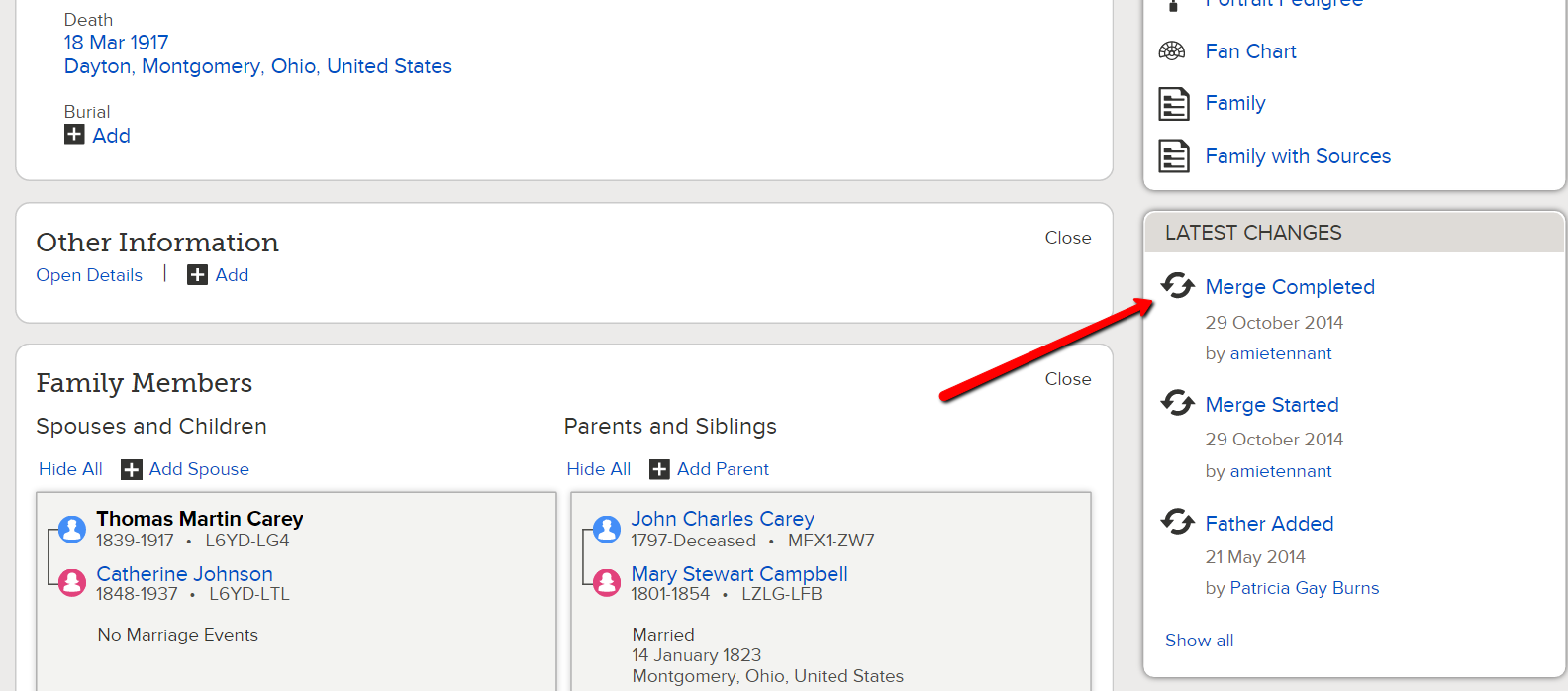
I have cleaned up nearly all my family tree, so I am going to use another family for this example. Thanks to friend Doug Carey for giving his permission to use his family names!  This person is Thomas Martin Carey.  I find him on the family tree and click his name.

Click the "Person" in Thomas Martin Carey's box and it will take you to his details page:


Scroll down to the bottom and over to the right you will click "Possible Duplicates".  In this case, there was something to merge.  


You need to click on "Review Merge".  It takes you to a split screen with your information on one side and the information of the other person on the other side.  This allows you to see if you would like to merge them AND you can use information from the other record to "add" to your own.  Here is the picture of the 2 Thomas Careys for me to review.  My original record is on the left and the one that is referred to as the "other" is on the right.
  
Everything looks good.  I have added the marriage date and location for Thomas and Catherine to my record and now I will continue with the merge.  Once you hit this, it will delete the one on the right and you are left with only one Thomas Martin Carey in the system.  Before the final merge, the system will ask you to give a reason you think this is correct.  I usually write something like "This person was in the system more than once" or "Thomas was recorded as Thomas M. Carey and his full name is actually Thomas Martin Carey".

If there are more than one record that should be merged, you simply go through the process over and over until you have merged each one that is a duplicate.  If you accidentally merge something that should not have been merged, that is okay...it can be fixed.  On the details page, near the middle and over to the right, you will see a section called "Latest Changes".  By clicking on the merge you just created, the system will ask you if you wish to "unmerge".  

Continue on with each of your ancestors until you have "cleaned up" everyone.  A long process, but worth it!  Happy hunting!


Wednesday, September 3, 2014

Finding the Missing Children

One of my favorite parts of family history is when I am able to find all the “lost children”.  In other words; some children are never found with their parents in the census records and therefore, they are lost!

For instance, if little Susie is born in 1881 and she marries before 1900, you would likely not find her in any census with her family and she might be overlooked. (The 1890 census was destroyed in a fire in 1921)

Or if little David was born in 1853 and died before 1860, you would not find him listed with his family either.  And so, many children are “lost” in this way.

I have come up with a method that helps to find some of these lost children.  It is not fool proof, but it certainly is a start.

First, I find all the censuses for any given family.  In particular, if you can find the female (mother) listed in the 1900 or the 1910 census, then you will notice that there were 2 special questions asked to women:  How many children have you had? and How many of those children are living?

The 1900 census asks these questions in columns 11 and 12.  The 1910 census asks them in columns 10 and 11.  From these numbers, you may be able to deduce how many children you have yet to “find”.

1910 Federal Census for "Margarett Cole", Harlan, Kentucky

In my case, I was able to see that Margaret had 12 children, but only 6 were living.  At that time, I only had 6 children listed on my family group sheet.  Going back to each census, I found a daughter named Victoria that only shows up with her family in one census before she died.  I later learned that there was no birth or death record for Victoria either.  If I had not seen her on this one census, I would have never known she existed.  I did not find any of the other missing children listed on other censuses, however I had another trick up my sleeve.

Next, I like to do 2 special searches on FamilySearch.org.  These work particularly well if your mother lived in only one or two areas.  In my case, Margaret lived in Harlan, Kentucky and Lee County, Virginia. By going to the Kentucky birth records directly, you can do a search for anyone with the last name of Cole, born in Harlan (county) with parents named Jacob and Margaret.  You do this by going to “Search” and clicking on the map on the right.  Then choose “Kentucky”.  

screen shot from www.familysearch.org


You will notice many available databases for Kentucky.  I then choose “Kentucky Birth and Christenings”.


I put in a last name only (Cole), a county (Harlan), and parents (Jacob and Margaret with no last names).  I have noticed that in this case, Jacob sometimes went by Jake.  After I have searched under the name of “Jacob”, I go back and search with the father’s name as “Jake”.

I did not find any children that I didn't already know about.

Next, I go back to my list of all the Kentucky databases and choose the “Kentucky Death Records” and do a search for anyone with the last name of Cole who died in Harlan, with parents named Jacob and Margaret (or use Jake in place of Jacob).

I did not find any of the missing children.

Then I will check “Kentucky Marriage Records”.  I am looking for a daughter or son that may have married, especially for those children born in the early years of 1880 and married before 1900.  Using the same search criteria, use the last name of Cole, place of Harlan, and parent’s first names.

In all my Kentucky searches, I found no "missing children".  However, when I did the exact same searches in the Virginia databases I found this:

screenshot from FamilySearch

(Note:  Upon further research, I found that the little boy John, born 1884 and died 1887, was actually the son of Jacob and first wife, Kizzie Eldridge Cole.  Kizzie died sometime after 1884 and at the time of this child's death, Jacob had remarried to Margaret.)

Another way of finding lost children can be in biographical sketches.  These can many times be found online at google books.  I find them by going to Google Books and typing in a keyword search of “Harlan County, Kentucky History” or “Lee County, Virginia History”. 

Choose a book you are interested in viewing.  Books that have “read” are available for you to see online.  Once you click on the book, you will be able to view the book virtually.  You can do a search for the surname you are interested in by typing it in the search box to the left.

I did a search for a Fred Greear from Wise County, Virginia.  Within his biographical sketch, it listed seven of his eight children by name.

Screen shot from googlebooks.com for page 245 of "A Narrative History of Wise County, Virginia", by Charles A. Johnson

Biographical sketches can also be located in newspapers.  I was researching my Walls family line in Pike County, Ohio when I stumbled across a newspaper article in which my fourth great grandmother was being interviewed.  According to my research, she had 9 children.  Within this interview, she listed all 11 of her children by name, their spouses, and how many children they each had!  What a find!!

As we go back further in time, it may be harder to find these lost little ones, but using some of these techniques could help you root them out!  Look to see if you might be missing some children on your family tree.  Happy Hunting!!

Wednesday, February 5, 2014

Translating Letters From Hungary

Did you know that it is a fairly common practice among the Mormon faith to send out their young men and women at the age of 18 and 19 respectively, to serve a full time mission?  Yep.  And did you know that those missionaries are sent all over the world?  In fact, in my own family we have a French speaker, a Tagalog (a Filipino dialect) speaker, a Japanese speaker and three Spanish speakers!!
                
So what does this have to do with “Translating Letters From Hungary” you ask??
                
About a year ago, my cousin contacted me to do some genealogy work for her father’s Hungarian line.  At that time, she knew only that her father’s parents were Joe and Lillie (Eldridge) Nimety of Lee County, Virginia.  She had been told that Joe had had a family before marring Lillie and that there were other children.  She hoped to connect with these children and introduce her father to his half siblings. 
                
We started in the censuses and were fortunate to find Joe and Lillie listed in 1930 living in Lee County, VA.  On that census, Joe is listed as having arrived in America in 1903 and was naturalized.  From there, we went to Ancestry.com to the database entitled “US Naturalization Records – Original Documents, 1795-1972” to see if we could find his naturalization papers.  Sure enough, Joe had first filed a Declaration of Intention on 18 Dec 1920 and listed his first wife’s name!  What a find!  On this Declaration of Intention, we found other important information.  Joe listed his birthdate as 21 Sept 1886 and his birthplace as Kormend, Hungary.  He also stated that his wife, Mary Super, was born in Kormend, Hungary.
                
The next set of paperwork we located was the Petition for Naturalization dated 1 Nov 1927.  This time Joe listed his wife as Lillie Eldridge.  Uh oh…what happened to Mary!   Well, according to family tradition, Mary and Joe had divorced and Mary had gone back with the children to Hungary.  Using this paperwork and the marriage record I found for Joe and Lillie, the divorce seems to have occurred sometime between the year 1920 when the Declaration of Intention was filed and 1923 when Joe married Lillie Eldridge.  But how could I find the children born to that first union?  I searched the 1920 census high and low and found nothing.  I searched birth records in Lee County, I searched death records in Lee County, I searched everywhere I could think of!!   And just as I was about to give in, my cousin called.  She had in her possession 2 letters written to Joe in the years 1946 and 1947.  Perhaps these letters held some much needed information, but they were written in Hungarian and who could we find to translate them here in the small town of Piqua, Ohio?
                
Off to Facebook (a wonderful social networking site that has been a wiz at finding treasure troves of genealogy information and connecting with long, lost cousins)!   I posted, “Attention all my Mormon returned missionaries!!  Does anyone speak Hungarian?”  Sure enough, in just a couple of days I had a response!  A friend-of- a- friend served his mission in Hungary and would be happy to translate them for us…for free!  I emailed the scanned letters and in no time, we had our translations.  Following are the letters.  I will let you judge for yourself if it was a real “find” or not!
               
So remember, even though you many not live in a big city, you can always find a translator among your friendly, neighborhood Mormon returned missionaries!!

Letter 1
8 Mar 1946
My dear father,
I give thanks to God that I am well now.  From the bottom of my heart I wish good health and lots of luck to you and to my stepmother and siblings.
I am happy to tell you that we have endured this difficult war with the exception of poor Liysa. God rest her ashes.  She was killed in a bombing.
Please don’t be upset that I haven’t written much but the winds of fate have again separated us from each other and I didn’t know your address.
I found my little sisters.  Thank God they are also well.  They have both married.  Vilma has a small family; one boy, one girl.  Iren has a little girl.  My little girl is five years old.  You have four beautiful granddaughters here in Hungary who all send kisses to their grandfather, who they may not see in this life.
Dad, I don’t want to beg because I understand your situation as well.  I know that it is difficult to provide food for a family even in America.  But I am finally able to search for work if there were any.  I am a [something similar to a central heating and or plumbing] contractor’s assistant.  Unfortunately, it is not possible to get along here in Hungary.  I don’t say this to complain.  To this point in my life I have not starved, even now with no work.  I ask just one thing of you; that you find my birth certificate and send it to me.  I believe you can find it in Mount Morris, Michigan as that’s where I was born.  I hope that will enable me to travel to America for work.  I would not be a burden on you for a single minute.  I am able to find my own place and work.  Thank God I am healthy and I wish the same for you, dear father.
Again, I ask just this one thing.  Find my file and send it to me.  And, if you are in excellent material standing, help me to collect the money to come there, God willing, I’ll make it to America and give back what you’ve given me.  If you cannot do without, even a few dollars would help.  The dollar is very valuable here.
Dear father, I must end my letter.  Lots of kisses to my whole family.  To you, to mom, to my siblings.
Kisses, 
Jozsef Joska, Monci, my wife and Ersik, my little girl

Letter 2
25 Jun 1947
(Iren speaking)
Dear Dad, I hope this letter finds you in the best of health and strength.  I write these few lines with tear-filled eyes.  I, rather we, live in a world without mother and without father.  These rows don’t allow me to express the joy and happiness I feel at exchanging words with my dear dad, if only in letters.
Of course, I would be happier if we could see each other and speak with one another.  But I am so happy to be able to write to you.   After all, not even this was possible until now.  Dad, I would have written much sooner but, unfortunately, I did not know your address. My elder brother, Jozsi, finally sent it to me in mid-June.
I am your youngest daughter, Iren.  I have been married since 1940 and now have two children.  We have a 3.5 year old daughter and a 3.5 month old son.  Our daughter is named Irenka and our son is Imre.  We thank God they are healthy.  We had one son die who would now be 2 years old.
Dad, how is your health?  Write more about your life.  Are you alone or do you have someone?  I hope things are better for you there than they are for us here.  Besides our health we don’t have much to be happy about.
My husband, Jani, is a machinist with a few jobs going.  It is very difficult to be happy in our current situation.  He is overcome with bills that need to be paid.  We hope the situation will someday be better.
(Janos, husband of Iren, now speaking)
Dear Dad,
First off, I need to ask your forgiveness for calling you Dad so confidently despite our not being familiar with one another.  Getting to know each other gives me endless joy, even if it is only through letters.  We could do it better in person but that seems nearly impossible.  I’m happy to have this much.  I write these few lines in silent faith and with eager hopes that my father-in-law is in America and when this is over we will live in milk and butter.  But it feels good to be able to write these few sincere lines.
I have undertaken the role of a spouse in your lovely daughter’s life.  I express my complete satisfaction with her as a good wife and mother.  Charitable children come from charitable families and so I ask you to accept my sincere appreciation and respect.
We are going to prepare a family portrait and will send it in the next letter so that you can see your grandchildren as well.  I would also ask, if it is within your power, please obtain and send my wife’s birth certificate.  This isn’t urgent and please don’t postpone your next letter for it.  In case you need the information, Iren was born 24 Mar, 1920 in Virginia.  For now we bid farewell and send out kisses with love.  We await your reply.
Iren and Jani
Irenka sends kisses to her grandfather


Monday, February 3, 2014

Never Take Leave of Your "Census"

The more I study the information that can be gleaned from a census, the more I fall in love with them.  They are not perfect, but boy can they paint a picture of your ancestor’s life.
I think it is very important to understand some details about censuses, census takers, and the like.

The US federal censuses are taken every 10 years.  The United States started taking censuses for apportioning the number of federal representatives from each state for tax levy purposes in 1790, but, genealogy information was a by-product.[1]  I will focus on the population schedules, although, there are many types of censuses that you may have overlooked.  Agriculture, Industry/Manufacturing, Mortality, and Slave schedules are just a few.

Between 1790-1870, the duty of collecting census data fell to the U. S. Marshals.[2]  A marshal could appoint as many “assistants” as they needed to get the job done.  Before 1830, there were no printed schedules, so you may see some censuses that look like the columns are just written on paper…that’s because they were!  A census worker was not necessarily well educated or qualified.  Penmanship was not a prerequisite!

Wages were not an incentive to become a census worker.  It was hard work and long hours for not much pay.  In 1790, which was the highest pay rate, the worker was paid $1.00 per 50 people.  By 1920, the census worker was paid between $.01 and $.04 per person![3]  I am sure the census taker was not thinking that these records would be used for generations for the use of research; therefore, perhaps they did not worry about “little errors”.

In March of 1879, an act replaced the marshals with specially trained and hired census-takers to conduct the 1880 and subsequent censuses.

There was often confusion of jurisdictions.  An area was divided into districts and sometimes into sub-districts.  These boundaries were often poorly defined and a census worker may be unsure if a household lay in their jurisdiction or another.  This is one reason a family may be enumerated more than once.

Prior to 1880, as the enumeration of each sub district was completed, the enumerator was instructed to make two copies, which were “carefully compared to the original for accuracy”.[4]  That last part sends up a red flag to me!  We all know that hand copies may produce mistakes no matter how carefully it is compared for accuracy!


When you are viewing “an original” census record, it is difficult to tell if you are looking at the original or one of the two copies.  So you see; there were three records of any given census prior to 1880.  One set was filed with the County Clerk, one set went to the State and the third set went to the US Census Office.  You can tell which copy went to the Census Office because there will be tabulations directly on the schedule.

In 1880, the practice of making copies was ended and the originals went back to the Census Office.
Prior to 1850, typically only heads of households were listed by name.  There were no exact ages given, but rather a tally mark in a column which was dedicated to a span of ages.  In 1850, everyone in the household was listed by name, age, and place of birth.  In 1880, a person’s relationship to head of household was recorded and not only where the individual was born, but where their father and mother were born.

Ever notice that the 1890 census is not available?  It was destroyed.  The building it was located in was burned in a fire in 1921.  Less than 1% of the census survived.[5]  Over 6,160 names of persons survived in fragments covering 10 states and the District of Columbia.[6]  See http://www.archives.gov/research/census/1890/1890.html for a list of the surviving records.

Naturalization information can be found on censuses for the years between 1900 and 1930.  The questions vary from census to census.  It is important to pay attention to what the question was.  You might notice some abbreviations.  NA – means naturalized, PA – first papers filed (Declaration of Intent), AL – Alien

The 1900 US Federal Census is my favorite.  Why?  It is the only census that lists the MONTH and YEAR of birth for every individual.  It is the only census that has this information.

The most recent census available to the public is the 1940 census.  It was made available in 2012. The 1950 census will not be available until the year 2022, 72 years after it was taken.  The 1940 census was unique in that it asked where the person was living 5 years earlier in 1935.  

Take some time to gather your "census" and use them to paint a picture of the life of your ancestor!


Goldie Cole and her children.  Pennington Gap, VA ca. 1953
PS...want to hear something kind of funny?  Pictured above is my grandma Goldie Cole and some of her children.  She once told me she hated "those census people" and sometimes she would hide the kids in the back room and tell them to "hush up".  Then, she would lie about how many kids she had, their names, and ages.  She didn't want the government knowing her "business".  Keep that in mind when you are looking over these census records.  The information is only as good as the person giving it and if the person wanted to lie, well...the census worker wouldn't have known!


[1] “Overview of the US Census”, internet article, Ancestry.com (www.ancestry.com:  accessed 3 Feb 2014); citing original article “Census Records” by Loretto Dennis Szucs & Matthew Wright in The Source:  A Guidebook to American Genealogy.
[2] “How Were Census Takers Instructed on How To Conduct The Census?”, internet article, United States Census Bureau (www.census.gov/history:  accessed 3 Feb 2014).
[3] “Overview of the US Census”, internet article, Ancestry.com (www.ancestry.com:  accessed 3 Feb 2014); citing original article “Census Records” by Loretto Dennis Szucs & Matthew Wright in The Source:  A Guidebook to American Genealogy.
[4] ibid
[5] “United States Census 1890”, online article, FamilySearch (www.familysearch.org:  accessed 3 Feb 2014).
[6] “The 1890 Census”, online article, National Archives (http://www.archives.gov/research/census/1890/1890.html: accessed 3 Feb 2014).